Use Savings to Buy a Home or Flip?
Homes are expensive, so the real question is how your cash works hardest — locking into a primary-residence mortgage and decades of interest, or putting capital into a fix and flip that can return profit if the deal pencils.

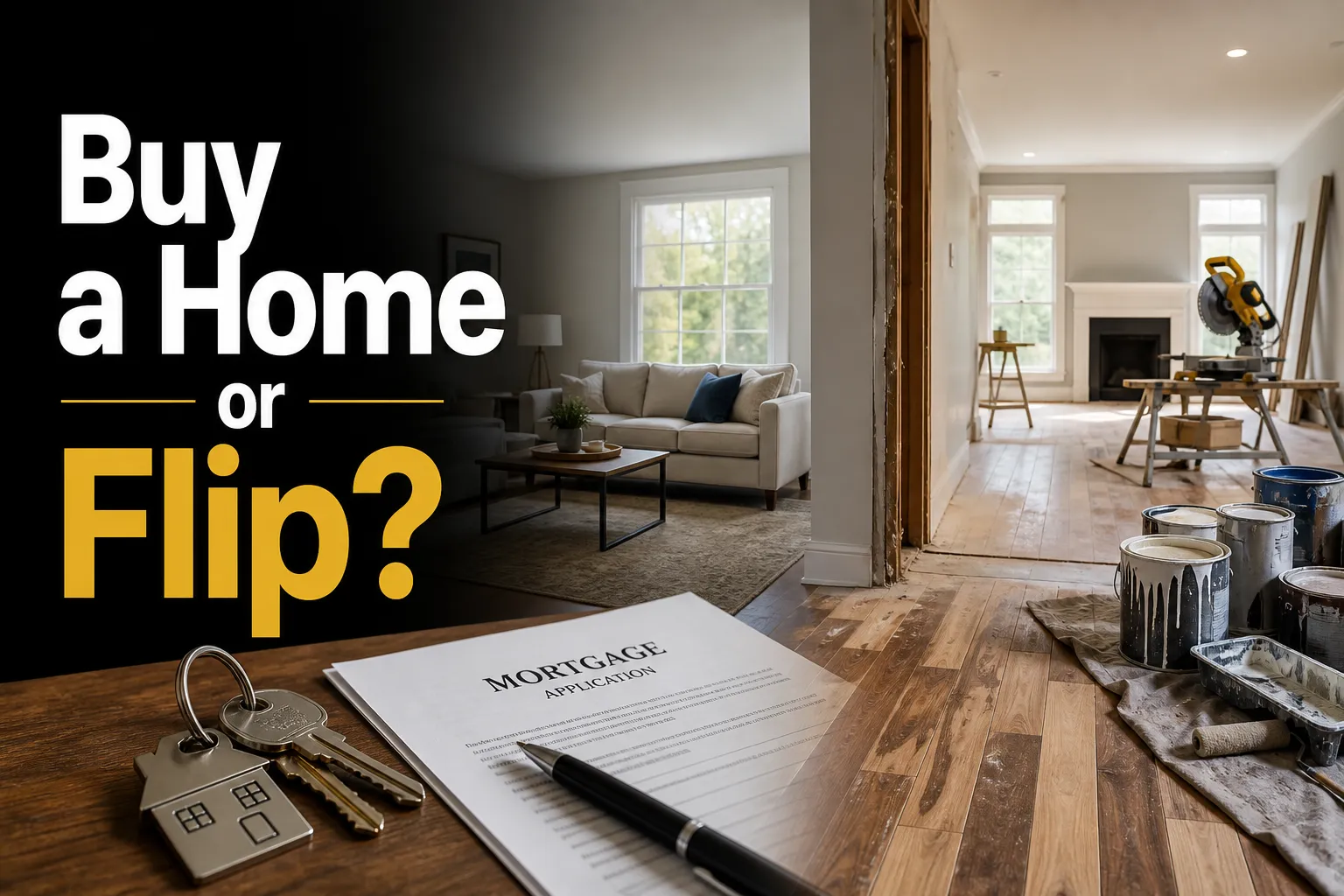
Neither choice is automatically right. With home prices and carrying costs high, the smarter question is how you want your limited cash to work — as a down payment on a place you live in, or as the equity slice of a fix and flip project you intend to sell.
I talk to people every week who have finally saved enough for a down payment and then freeze. They know buying a primary residence is the path most people take. They also know investors use hard money and a smaller cash stack to buy, renovate, and exit. This post is not a sales pitch for either lane. It is a clear comparison of how the capital, risk, and lifestyle differ so you can decide with eyes open.
Why Does This Decision Feel Harder Right Now?
Because entry prices and monthly payments are heavy. A primary home often means a large down payment, closing costs, and a long-term mortgage where a meaningful share of early payments goes to interest. That is a real cost of homeownership, not a gotcha.
On the flip side, a fix and flip can look like a way to put the same cash to work for a finite project with a defined exit. It can also wipe you out if purchase, rehab, or after repair value (ARV) assumptions are wrong. Expensive markets raise the stakes on both paths. Capital that used to feel “enough” for a house may now force tradeoffs — neighborhood, size, timeline, or whether you buy at all.
What Are You Actually Buying With a Primary Residence?
You are buying shelter, stability, and a consumer mortgage product. Your cash becomes equity in a home you live in. The loan is underwritten to you as a person — income, credit, debt-to-income — not to a renovation business plan.
Typical tradeoffs on this path:
- Cash use: Down payment plus closing costs and moving-in reserves. That money stays in the house until you sell or refinance.
- Ongoing cost: Principal, interest, taxes, insurance, maintenance. Interest over a full term is often larger than people expect when they only look at the sticker price.
- Timeline: Years or decades. The “return” is partly financial (equity and appreciation) and partly lifestyle (a place you control).
- Risk profile: Payment stress, rate resets if you choose an adjustable product, repair surprises, and local market swings. You are not timing a 6-month exit.
None of that makes buying “wrong.” It means your savings are locked into a long-horizon, personal-use asset.
What Are You Actually Buying With a Fix and Flip?
You are funding a short-term investment project. At Best Lending Co, fix and flip loans are business-purpose financing — purchase and rehab capital aimed at a sell (or sometimes refinance) exit, not a primary-residence mortgage.
Cash in a flip usually covers:
- The down payment / equity portion of the purchase
- Closing costs
- Reserves we typically want to see: about six months of interest-only payments plus 20% of the rehab budget
On many deals, experienced borrowers can finance up to about 90% of purchase and 100% of rehab (subject to loan-to-cost and loan-to-ARV caps). First-time investors still qualify with us, usually with slightly tighter leverage and pricing. The point for this comparison is simple: your cash is the gap between total project cost and what the hard money loan funds — not necessarily the full purchase price in cash.
On a financed flip, savings often cover equity, closing costs, and reserves — not the entire purchase ticket.
How Do the Cash Flows Differ Side by Side?
| Primary residence | Fix and flip | |
|---|---|---|
| Job of your cash | Down payment + closing into a long-term home | Equity + reserves into a project with a planned exit |
| Loan type | Consumer mortgage | Business-purpose hard money (interest-only while you hold) |
| How you “win” | Shelter, equity build, long-term appreciation | Profit after purchase, rehab, holding, and selling costs |
| Holding period | Years | Often months (plan for overruns) |
| Biggest silent cost | Interest and lifestyle carrying costs over time | Holding costs, rehab overruns, soft ARV |
| If numbers miss | You still live there; payment still due | Profit shrinks or disappears; you may need more capital |
A mortgage payment is predictable relative to a flip, but it is not free. A flip can return cash after sale, but only if the deal pencils and execution holds. Same savings account. Different jobs for the money.
What Risks Does Each Path Carry?
Primary residence risks lean personal and long-term: payment affordability if income changes, maintenance, and the opportunity cost of cash sitting in one house instead of other uses. You also take on decades of interest if you keep a large balance outstanding.
Fix and flip risks lean operational and short-term: buying too high, underestimating rehab, overestimating ARV, slower sales, and interest while the project runs. Interest on our fix and flip loans is typically interest-only and accrues on disbursed funds — still a real burn if the project drags.
Expensive markets do not invent these risks. They amplify them. Thin margins leave less room for a bad appraisal, a contractor delay, or a rate that is higher than you planned.
What Lifestyle and Skill Differences Matter?
Buying a home asks you to be a homeowner — maintenance, neighborhood fit, commute, school, and whether the payment still works if life changes.
Flipping asks you to run a small construction business for a season — scope writing, contractor management, draws, and an exit plan. First-timers can get funded with us, but the skill demand is real. A house you live in does not require you to manage a rehab crew. A flip does.
Ask yourself honestly:
- Do I want this cash tied to where I sleep, or to a project I intend to exit?
- Am I prepared for contractor risk and a sale timeline — or for a long mortgage and home upkeep?
- If the flip loses money, can my household absorb it? If the mortgage gets tight, can we adjust?
How Should You Think About Interest vs. Potential Profit?
This is the comparison people feel in their gut.
On a primary residence, a large share of early payments can go to interest. Over a full amortizing term, total interest paid can rival or exceed what felt “small” when you only compared monthly payments. You are paying for the privilege of stretching the purchase over time while you live in the asset.
On a fix and flip, interest is a project cost during the hold. Profit — if any — is what remains after purchase, rehab, holding costs, selling costs, and that interest. You are not “avoiding interest.” You are choosing a different interest profile: shorter duration, project-based, in service of a resale (or refinance) thesis.
Neither math is automatically better. One subsidizes long-term occupancy. The other tries to produce a discrete profit event. Run both with your numbers, not internet averages.
- Primary path Map down payment, closing costs, full PITI, and a rough lifetime interest picture on the loan you would actually take.
- Flip path Map purchase, rehab, ARV, selling costs, hold months, and interest on drawn balances — then stress-test ARV down and rehab up.
- Shared question After either use of cash, what liquidity do you still have for emergencies?
- Honest filter Which outcome do you need more right now — a place to live, or a project that might return capital?
Can Someone Do Both Over Time?
Yes. Plenty of investors buy a primary first, then flip later — or flip, build liquidity, then buy a home. Sequence is personal. What does not work well is treating a flip like a primary (living in unfinished inventory) or treating a primary like a flip (expecting a quick profit that consumer mortgages and life rarely deliver on schedule).
If you are comparing paths because you only have one pile of savings, pick the job that matches your next 12–24 months of life, not a Twitter debate.
Frequently Asked Questions
Is flipping always a better use of cash than buying a home?
No. Flipping can return profit when the deal is strong and execution holds. Buying a home delivers shelter and long-term equity. “Better” depends on whether you need a place to live, how much risk you can take, and whether a specific deal actually pencils.
Do expensive home prices mean I should flip instead?
Not by themselves. High prices raise the cash needed for both a down payment and a financed flip’s equity and reserves. Expensive markets make capital allocation more important; they do not automatically make flipping safer or smarter.
How much cash do I typically need to flip with hard money?
Enough for your equity portion, closing costs, and reserves. At Best Lending Co we typically look for about six months of interest-only payments plus 20% of the rehab budget in reserves, on top of what you bring for the down payment side of the file. Exact cash-to-close depends on the property and your experience.
Will a primary-residence mortgage use the same underwriting as a fix and flip loan?
No. A home loan is a consumer mortgage underwritten to personal income and credit. A fix and flip loan with us is business-purpose financing focused on the deal, your liquidity, credit, and experience — not the same product or process.
What if I am not sure which path fits me?
Run the numbers both ways on a real address and a real budget. Talk to a mortgage professional about the primary path and to me about a specific flip file if you have one. The goal is clarity, not pressure to pick a lane today.
Want a clearer picture of the flip side of this comparison?
Run the Fix & Flip Profit Calculator or book a call if you have a property to talk through — no pitch to buy or flip, just straight numbers.